

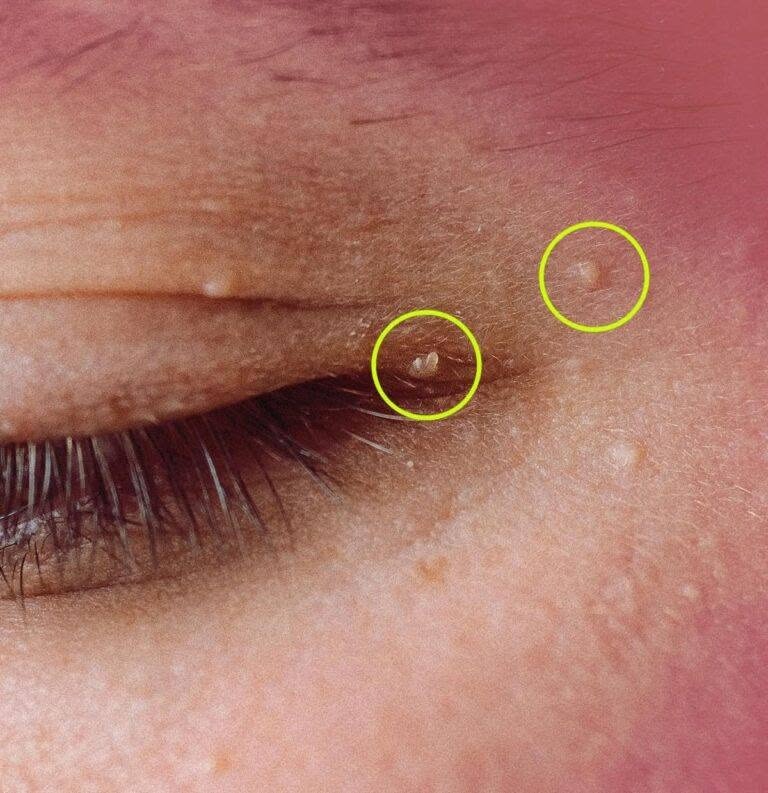
You look closely in the mirror one morning and notice several tiny white bumps around your eyes or across your cheeks. They don’t look quite like ordinary pimples, and no matter how carefully you wash your face, they don’t seem to disappear.
These little bumps are often called milia.
Although they can be frustrating from a cosmetic point of view, milia are usually harmless. They aren’t the same as acne, and trying to squeeze them like pimples can actually make matters worse.
Understanding what milia are—and what they aren’t—is the first step toward dealing with them safely.
What Are Milia?
Milia are tiny cysts that form just beneath the surface of the skin.
They contain keratin, a protein naturally found in the skin, hair, and nails. When keratin becomes trapped beneath the skin instead of being shed normally, a small, firm bump can develop.
A single bump is technically called a milium, while several bumps are called milia.
They usually appear white or pearly and can sometimes have a slightly yellowish appearance.
Unlike many pimples, milia usually aren’t red, swollen, or painful.
Where Do Milia Usually Appear?
Milia can develop almost anywhere, but they’re particularly common on the face.
Typical locations include:
Around the eyes
On the eyelids
Across the cheeks
Around the nose
On the forehead
They can occur in people of different ages and skin types. Milia are particularly common in newborn babies, but children and adults can develop them as well.
Are Milia the Same as Whiteheads?
No.
This is one of the most important things to understand.
A whitehead is a type of acne lesion involving a clogged pore. Milia are small cysts containing trapped keratin.
Because they’re different conditions, squeezing a milium as though it were a whitehead usually doesn’t work.
The keratin is enclosed beneath a thin layer of skin.
Trying to force it out can instead cause irritation, bleeding, infection, discoloration, or scarring.
Are Milia Dangerous?
Continued on next page:
In most cases, no.
Ordinary milia are benign and are generally a cosmetic issue rather than a health problem.
They don’t usually require treatment.
Some disappear naturally.
Others—particularly in adults—can remain noticeable for considerably longer.
If the bumps bother you cosmetically or you’re uncertain whether they’re actually milia, a dermatologist can examine them.
That’s particularly useful because several other skin conditions can sometimes produce small bumps that resemble milia.
What Causes Milia?
There isn’t one single cause that applies to every person.
Primary milia can appear without an obvious preceding skin problem.
Other forms can develop after the skin has been damaged or injured. DermNet notes that secondary milia may develop following burns, blistering skin conditions, or other forms of skin injury.
The important point is that milia aren’t simply caused by having a “dirty face.”
Excessive washing therefore isn’t the solution.
In fact, aggressively scrubbing your face in an attempt to remove them may simply irritate your skin.
Can Heavy Skin-Care Products Cause Milia?
This is sometimes discussed as a contributing factor, particularly with very heavy or occlusive products, but the causes of milia can vary.
If you notice that small bumps repeatedly appear after introducing a particularly rich facial or eye product, consider discussing your routine with a dermatologist.
You can also try simplifying your skin-care routine and choosing products that feel appropriate for your skin type.
But don’t automatically blame one moisturizer for every milium.
Do Milia Go Away Naturally?
They can.
Many cases don’t require treatment at all.
Cleveland Clinic notes that milia can disappear without treatment, although the amount of time they remain can vary.
This means that if you have a few small bumps that aren’t causing any discomfort, simply leaving them alone is a perfectly reasonable option.
Treatment is usually pursued because someone doesn’t like their appearance rather than because the milia are dangerous.
The Biggest Mistake: Trying to Pop Milia
Continued on next page:
When people discover a tiny white bump, their first instinct is often:
“I’ll just squeeze it.”
Don’t.
A milium isn’t sitting inside a pore waiting to be popped like an ordinary pimple.
The material is trapped beneath the skin.
Repeated squeezing can damage the surrounding tissue without actually removing the cyst.
Cleveland Clinic specifically advises against trying to squeeze or scrape milia at home because doing so can cause infection or scarring.
This warning becomes even more important around the eyes.
Never start experimenting with needles or blades near your eyelids.
What About Using a Needle at Home?
Professional removal sometimes involves carefully opening the surface and extracting the keratin.
That doesn’t mean you should reproduce the procedure yourself.
Dermatologists have appropriate equipment, lighting, sterile technique, and knowledge of skin anatomy.
At home, it’s easy to puncture too deeply, introduce bacteria, cause bleeding, create a scar, or injure delicate tissue.
And around the eye, the consequences of an accident can be much more serious.
Leave extraction to an appropriately trained professional.
Can Steam Remove Milia?
Steam is frequently promoted online as a home treatment.
A warm shower or gentle facial cleansing may feel pleasant, but there’s no good reason to expect steam alone to make an established keratin cyst suddenly disappear.
Milia aren’t simply dirt trapped inside an open pore.
Therefore, claims that steaming “opens the pores and releases the milia” oversimplify what’s happening.
If you enjoy gentle warmth as part of your skin-care routine, that’s different.
Just don’t expect it to function as a guaranteed milia treatment.
And avoid extremely hot steam, which can irritate or burn the skin.
Should You Put Lemon Juice on Milia?
This is another popular internet remedy that should be approached cautiously.
Many DIY recipes recommend combining lemon juice with sugar or other ingredients and rubbing the mixture across the face.
That’s not necessary.
Lemon juice is acidic and can irritate sensitive facial skin.
The skin around the eyes is particularly delicate, making aggressive DIY treatments a poor choice.
You don’t need to burn, sting, or aggressively scrub your skin to deal with milia.
What About Sugar Scrubs?
Continued on next page:
Harsh physical exfoliation isn’t the answer either.
Large sugar particles rubbed vigorously across facial skin can cause irritation.
If you’re already dealing with sensitive skin or bumps around your eyes, aggressive scrubbing may create an additional problem without removing the milia.
Gentle skin care is usually a better strategy than trying to mechanically scrub the cyst away.
Does Honey Remove Milia?
Honey has characteristics that have led to its use in many traditional skin-care preparations, but that doesn’t establish it as a reliable treatment for removing established milia.
If you enjoy a properly formulated honey-containing cosmetic product and your skin tolerates it, that’s one thing.
But you shouldn’t expect honey to dissolve a keratin cyst beneath the skin.
The same principle applies to many viral DIY remedies.
“Natural” doesn’t automatically mean effective, and it doesn’t automatically mean irritation-free.
What About Pomegranate Peel?
Ground pomegranate peel mixed with honey is another remedy sometimes promoted online.
However, it isn’t an established first-line dermatological treatment for milia.
There is no need to repeatedly apply abrasive homemade mixtures to your face in an attempt to remove these bumps.
If milia aren’t bothering you, leaving them alone is safer.
If they are bothering you, evidence-based skin care or professional treatment makes more sense.
A Better At-Home Approach
For most people, an at-home routine should focus on keeping the skin healthy rather than trying to physically remove each milium.
Start with a gentle cleanser.
Wash your face without aggressive scrubbing and gently pat the skin dry.
Cleveland Clinic recommends routine gentle cleansing and sun protection as reasonable home-care measures.
Keep the routine simple and consistent.
Gentle Exfoliation May Help Some Adults
Adults may consider appropriate exfoliating products to support normal skin-cell turnover.
But “more exfoliation” doesn’t mean “better.”
Over-exfoliating can damage the skin barrier, causing redness, burning, dryness, and irritation.
If you use an exfoliating product, follow its directions and introduce it gradually.
Be particularly careful with products used near the eyes.
What About Retinoids?
Continued on next page:
Topical retinoids are among the treatments that may be considered for some people with milia.
Cleveland Clinic lists over-the-counter adapalene and prescription tretinoin among potential treatment approaches, while DermNet notes that topical retinoids may be useful for widespread milia.
But retinoids can cause irritation and aren’t appropriate for everyone or every area of the face.
Don’t casually apply a strong retinoid directly next to your eyes.
If your milia are concentrated around the eyelids or you’re unsure what product is appropriate, ask a dermatologist.
Pregnant people or those trying to become pregnant should also seek medical advice before considering topical retinoid therapy.
Don’t Forget Sunscreen
Sun protection is another sensible part of a healthy skin-care routine.
Use a broad-spectrum sunscreen appropriate for your skin and follow the product directions.
This won’t necessarily make an existing milium disappear overnight, but protecting your skin from excessive UV exposure has benefits far beyond milia.
Cleveland Clinic includes sunscreen among its home-care recommendations for people with milia.
Professional Extraction
If you want an established milium removed quickly, professional extraction is one option.
A healthcare professional can carefully create a tiny opening and remove the trapped keratin.
DermNet describes de-roofing the lesion with a sterile needle or blade followed by removal of its contents as one treatment method.
This is very different from standing in front of your bathroom mirror and squeezing the bump.
Professional technique reduces unnecessary trauma and is particularly valuable when milia are located in delicate areas.
Other Treatments a Dermatologist May Consider
Not every case is treated the same way.
Depending on the number, location, and type of milia, professional options can include extraction and, in selected situations, treatments such as cryotherapy, curettage, topical retinoids, chemical peels, dermabrasion, or laser procedures.
That doesn’t mean someone with two tiny white bumps needs an aggressive procedure.
Most people don’t.
Treatment should match the individual situation.
What If the Bumps Keep Coming Back?
Recurring bumps are a good reason to have the diagnosis confirmed.
Something that looks like milia to you may occasionally be another type of skin lesion.
A dermatologist can distinguish milia from conditions that may look similar and recommend an appropriate treatment plan.
This is particularly useful if you’ve been treating the bumps for months without improvement.
Milia Around the Eyes Require Extra Care
Continued on next page:
The eye area deserves special attention because the skin is thin and sensitive.
Avoid putting harsh acids, homemade lemon mixtures, rough scrubs, or sharp objects close to your eyes.
If you have persistent bumps directly on or very close to your eyelids, professional evaluation is safer than attempting DIY extraction.
A tiny cosmetic bump isn’t worth risking an eye injury.
What About Milia in Babies?
Milia are extremely common in newborns.
DermNet and Cleveland Clinic report that roughly 40% to 50% of newborns develop them.
These tiny bumps generally don’t need treatment.
Don’t squeeze them.
Don’t scrub them.
And don’t start applying adult acne products, exfoliating acids, or retinoids to a baby’s skin.
Cleveland Clinic notes that neonatal milia typically resolve without treatment.
If you’re uncertain about any rash or skin lesion on a baby, ask the child’s healthcare professional.
Can Milia Be Prevented Completely?
Not necessarily.
Some people simply seem more prone to developing them.
Good skin care can help maintain the skin barrier and normal turnover, but there isn’t a guaranteed routine that prevents every milium.
You can nevertheless avoid unnecessary skin trauma, use products appropriate for your skin, protect yourself from excessive sun exposure, and avoid aggressive DIY extraction.
A Simple Routine for Milia-Prone Skin
Your routine doesn’t need fifteen products.
In the morning, gently cleanse your skin if needed, apply an appropriate moisturizer, and use broad-spectrum sunscreen.
At night, remove makeup and sunscreen thoroughly and cleanse gently.
If an exfoliating product or retinoid is appropriate for you, use it according to professional or product guidance rather than combining multiple strong ingredients at once.
Consistency is generally more sensible than aggressive treatment.
When Should You See a Dermatologist?
Continued on next page:
Consider professional evaluation if:
You’re unsure whether the bumps are actually milia.
They persist and bother you cosmetically.
Large numbers appear unexpectedly.
They repeatedly return.
The area becomes painful, inflamed, bleeding, or otherwise changes significantly.
They’re very close to your eyes and you want them removed.
Your home skin-care routine is causing irritation.
A dermatologist can confirm what you’re dealing with before you spend months treating the wrong condition.
What You Should Avoid
Perhaps the most important lesson is knowing what not to do.
Don’t squeeze milia like pimples.
Don’t puncture bumps near your eyes with a needle.
Don’t repeatedly scrape them.
Don’t aggressively exfoliate your skin.
Don’t assume lemon juice, sugar, honey, toothpaste, baking soda, or another viral kitchen remedy will safely remove them.
And don’t keep applying a product if it causes significant burning, swelling, or irritation.
Milia are usually harmless.
There’s no reason to turn a harmless cosmetic issue into an injured skin barrier, infection, or scar.
The Bottom Line
Those tiny white bumps around your eyes, cheeks, or nose may be frustrating, but milia are usually harmless keratin-filled cysts, not ordinary pimples.
Some disappear naturally and require no treatment at all.
If you want to manage them at home, focus on gentle cleansing, appropriate skin care, sun protection, and—when suitable—carefully selected products that support normal skin turnover.
Avoid squeezing, cutting, or aggressively scrubbing them.
For stubborn or cosmetically bothersome milia, a dermatologist can confirm the diagnosis and discuss professional extraction or other appropriate treatments.
The safest approach is often surprisingly simple:
Be gentle with your skin, give it time, and don’t turn a tiny harmless bump into a much bigger problem.
Thank you for visiting the site…